
A Pipe Has Burst: What to Do First, and in What Order
Turn the power off at the main breaker if the water has reached anything electrical, close the main shutoff where the water pipe comes into the house, then photograph everything before it is moved. The only repair that has to happen tonight is a temporary one: the permanent repair waits until your insurer, and for permitted work Onondaga County Plumbing Control, has had the chance to see it.
Already know you need someone out? Call (315) 640-3590.
The first hour after a pipe bursts, in order
Power off where the water has reached it
You, at the service panelThe CDC says wet electrical circuits and equipment, or anything in or near water, means the power goes off at the main breaker or fuse.
Close the main shutoff indoors
You, never the curb stopOCWA wants one customer valve within a foot of where the pipe comes through the wall and another at the meter. The valve out by the street belongs to utility staff.
Photograph before anything moves
You, before any cleanupThe insurer has the right to inspect the property in its damaged condition, so the record comes before the mop.
A temporary repair, with the receipt kept
A licensed plumberNew York's insurance regulator says the cost of protecting the property from further damage is generally covered, and to save every receipt for temporary fixes.
Tell the insurer, by phone and then in writing
You, keeping copiesLate notice might result in a denial of coverage, according to the same state guidance.
The permanent repair, after it has been seen
In daylightNo permanent repair before the insurer has inspected, and nothing covered over before Plumbing Control has inspected permitted work.
CDC disaster cleanup guidance; OCWA Customer Rules sections 4.4 and 4.5; NY Department of Financial Services, What to Do After a Loss; Onondaga County Plumbing Control permit requirements.
The order, and why it runs this way
A burst supply pipe does not run out of water. It is fed under pressure from the street and it keeps going until a valve is closed, so the first minutes are about stopping the supply, and none of that needs a plumber standing in the house. The Insurance Information Institute's advice for anyone whose pipes have burst starts in the same place: turn off the water first. Everything else on this page is there to protect you afterwards: keeping the house safe while you do it, closing the right valve and leaving the wrong one alone, recording what happened before it is cleaned up, and keeping the repair you pay for tonight as small as it honestly can be. If the water is still running and nothing electrical is wet, go and close the main shutoff now, as the section on valves below describes, and finish reading once it has stopped.
Make the house safe before you walk into the water
Water and electricity is the part of a burst pipe that can hurt someone, which is why it comes before the valve. The CDC's guidance is short and not open to interpretation: where electrical circuits or electrical equipment have gotten wet, or are in or near water, the power should be turned off at the main breaker or fuse on the service panel. That covers an outlet at floor level in a flooded basement, a washer or a dehumidifier sitting in the water, and a ceiling light below a pipe that has let go upstairs. If the water is pouring onto or around a gas water heater, that heater has its own first steps, and they begin with the gas utility rather than with a plumber: they are set out in the guide to leaking water heaters. Once the power question is settled, the water can be dealt with.
Close the valve where the water pipe comes into the house
The valve that stops a burst pipe is indoors, on the water service where it comes through the foundation, usually in the basement and usually near the meter. In the towns OCWA supplies, which include Clay, Cicero, Camillus, DeWitt, Manlius and Salina, its customer rules say exactly where to look: section 4.5 has every customer fit two shutoffs of their own, one within 12 inches of the point where the pipe passes through the foundation, and one at the meter itself. Close the first one fully. If it will not move, try the one by the meter. Leave the small metal cover out by the street alone, even if a neighbor tells you that is how it is done. That is the curb stop, and section 4.4 of the same rules says the customer may not use it to turn the water on or off and that it is operated exclusively by an Authority employee. If neither inside valve will close, the next move is the water utility rather than a plumber, because OCWA says it will close a customer's service at the road so that a repair can be carried out.
Photograph it before anything is moved or thrown away
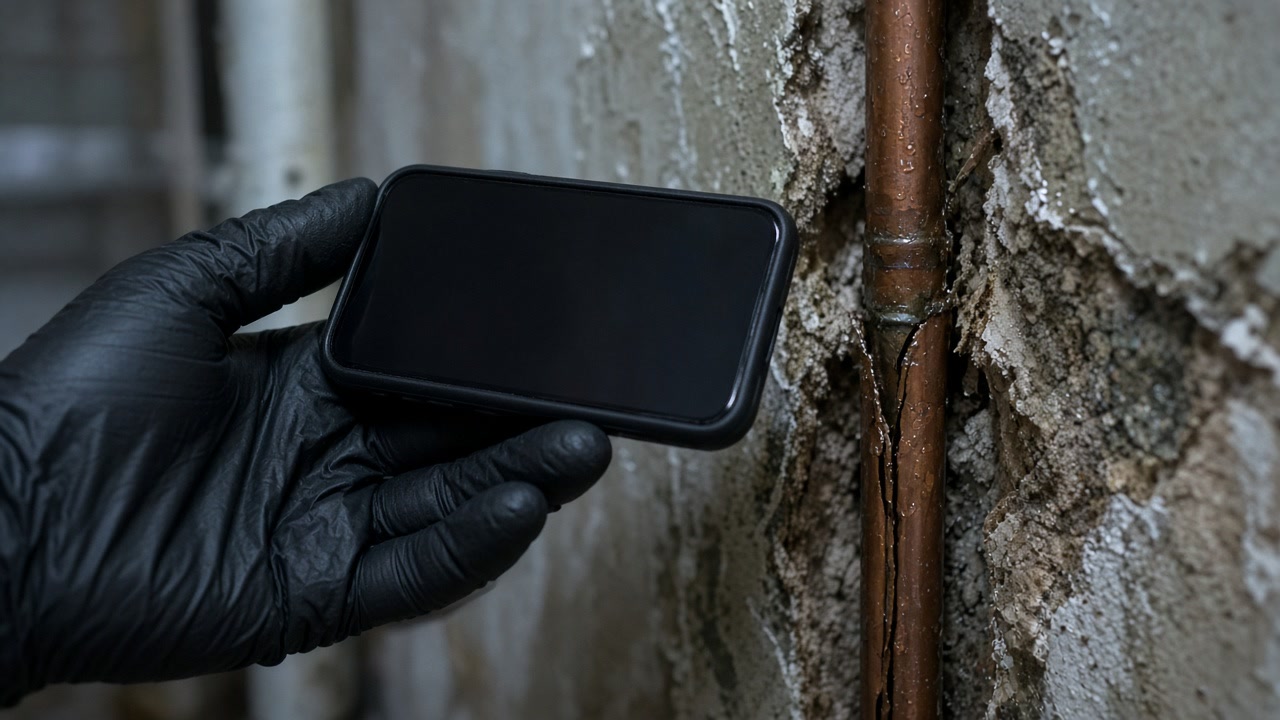
This is the step people skip, because the instinct with water on the floor is to clean. Take the pictures first. New York's Department of Financial Services says an insurer has the right to inspect the property in its damaged condition, and the standard homeowners form lists showing the damaged property as often as the insurer reasonably requires among the policyholder's duties after a loss, alongside an inventory of damaged belongings. So photograph the pipe or fitting that failed, the water where it is lying, the ceilings and walls it has reached, and the contents sitting in it, from far enough back that the room is recognizable. If the weather is cold, photograph the thermostat and what it reads. When the plumber cuts out the failed section, keep it in a bag with the date on it. Wet carpet, soaked boxes and ruined furniture can come out of the room so the space can be worked in, but not out of the house until they have been photographed and, if you intend to claim, until your insurer has said whether it wants to see them.
What has to be done tonight, and what can wait for daylight
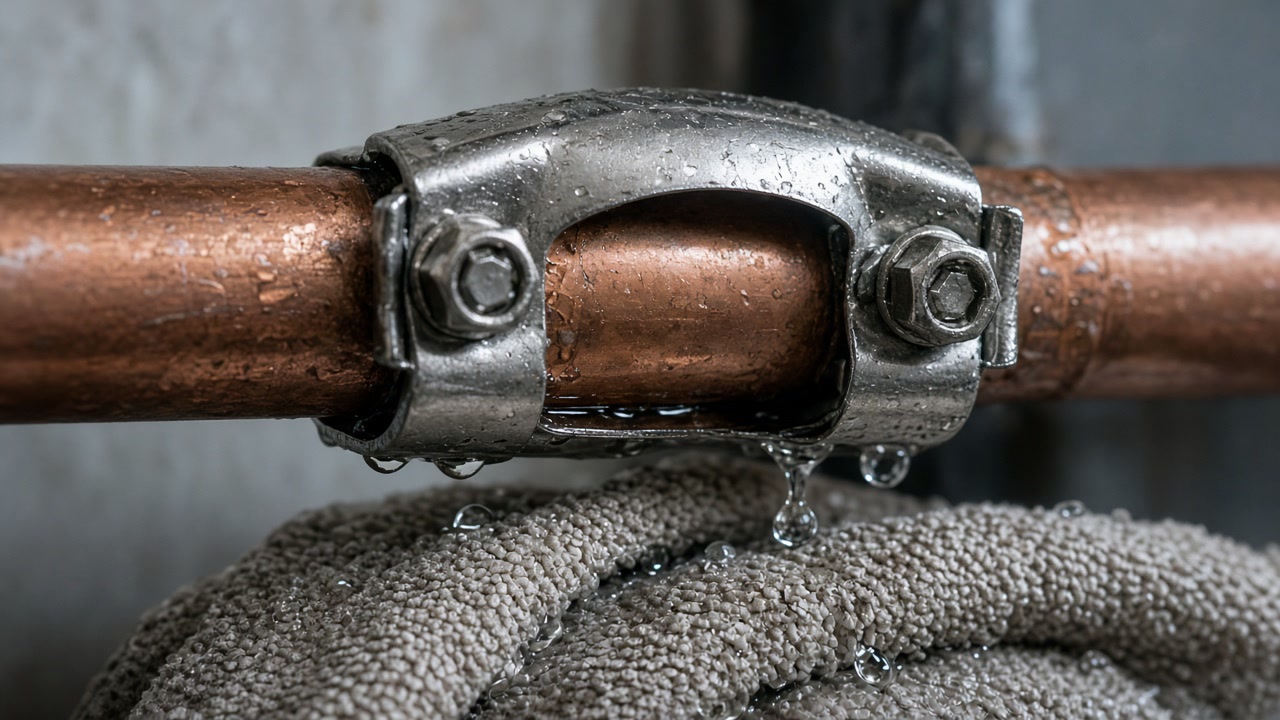
You do not have to buy the whole repair tonight, and New York's own guidance says you should not. The Department of Financial Services tells policyholders to protect the property against further damage, says the cost of that protection is generally covered and reimbursed, and asks them to save all receipts for temporary fixes. The same page says no permanent repairs should be made until the insurer has inspected, because it can refuse to pay for damage that is repaired first. Onondaga County Plumbing Control arrives at the same split from the other direction: emergency plumbing may start without a permit, the permit is due on the first business day afterwards, and nothing may be hidden behind a finished surface until the county has looked at it. So tonight's job is the water stopped, the house safe and a temporary repair that ends the leak and, where it can, gets water back to the rest of the house. Ask the plumber to write down what failed, what they did and what the permanent repair will involve. That note, and the receipt, belong with your photographs. The permanent work can then be quoted in daylight, by the same plumber or by someone else, without anyone standing over you at midnight.
Tell your insurer, by phone and then in writing
The same state guidance lists notice as the first thing to do after a loss: tell the insurance company or agent by phone, follow that with written notice, and keep copies of all of it. It is blunt about why. Failing to notify the company promptly might result in a denial of coverage. When you make that report, ask one question directly and write down the answer: does the insurer want to inspect before any permanent repair is made? The answer tells you how long the open wall or the bare subfloor has to stay the way it is. Whether the damage is worth claiming at all is a separate decision, and the guide to burst pipe insurance claims in New York goes through what the standard policy is written to pay for, the conditions that decide a frozen pipe claim and the deadlines that start running once you report.
When you may not need a plumber tonight at all
Some bursts are not emergencies once the water is off. If the failure was a braided supply tube under a sink, a toilet fill valve or a fixture's own small shutoff, the county treats it as ordinary maintenance: its permit rules exempt like for like work on a faucet, a flush valve, a supply tube, an individual fixture stop, a toilet fill valve or a flushing mechanism from needing a plumbing permit at all. Close the small valve feeding that one fixture, and the rest of the house can often have its water back on while you buy the part in the morning. And if the main is closed, nothing electrical is wet and the house can manage without water for a night, the repair can be booked in ordinary hours like any other job. If the water is off but what failed is a pipe in a wall, a ceiling or the floor, that is the part that cannot wait. Tell us what burst, where it is and whether the main is closed, and we will pass it to a licensed, insured plumber who works in your town for tonight's part, leaving the rest to be quoted in daylight.
Sources used in this guide
The Insurance Information Institute severe cold weather guide advises keeping the house heated to a minimum of 65 degrees because the temperature inside walls where pipes sit can be substantially colder than the room, letting hot and cold faucets drip slowly in severe cold, having the water system drained by a professional before an extended absence, and, if pipes burst, turning off the water first.
Source: Insurance Information Institute, accessed 2026-09-24
The CDC advises that if electrical circuits and electrical equipment have gotten wet or are in or near water, the power should be turned off at the main breaker or fuse on the service panel.
Source: Centers for Disease Control and Prevention, accessed 2026-09-24
OCWA's 2024 Consumer Confidence Report lists the Onondaga County municipalities it serves with their sources, including the towns of Camillus, Cicero, Clay, DeWitt, Manlius, Marcellus, Salina and Skaneateles and the villages of Camillus, East Syracuse, Fayetteville, Liverpool, Manlius, Marcellus, North Syracuse and Solvay. It marks the Village of Baldwinsville and the City of Syracuse as emergency connection only.
Source: Onondaga County Water Authority, accessed 2026-09-24
Section 4.4 of the OCWA Customer Rules states that the curb stop valve may not be used by the customer to turn the water on or off and is to be operated exclusively by an Authority employee. Section 4.5 requires the customer to install two shutoff valves, the first inside the building wall no further than 12 inches from that wall, and the second adjacent to the meter.
Source: Onondaga County Water Authority, accessed 2026-09-24
Asked about a leaking shutoff valve, OCWA states that it owns only the water meter and remote reader, that all plumbing and piping including the shutoff valves belongs to the owner, and that the owner can call OCWA's office to have the water shut off at the road while the repair is made.
Source: Onondaga County Water Authority, accessed 2026-09-24
The NY DFS guide says it is important to protect property against further damage, that the cost of that protection is generally covered and reimbursed, and to save all receipts for temporary fixes. It states that no permanent repairs should be made until the company or its representative has inspected the property, that the company has the right to inspect the property in its damaged condition, and that it can refuse to pay for damage that is repaired before inspection.
Source: New York State Department of Financial Services, accessed 2026-09-24
The Duties After Loss condition of the ISO HO 00 03 form requires the policyholder to give prompt notice to the insurer or its agent, to protect the property from further damage, to make reasonable and necessary repairs to protect the property, to keep an accurate record of repair expenses, to cooperate in the investigation, to prepare an inventory of damaged personal property with bills and receipts, and to show the damaged property as often as the insurer reasonably requires. The form states the insurer has no duty to provide coverage if failure to comply with these duties is prejudicial to it.
Source: Insurance Services Office, via Maine Bureau of Insurance, accessed 2026-09-24
Onondaga County Plumbing Control states that plumbing permits must be obtained before any work except in an emergency, that in an emergency a permit must be obtained on the first business day following it, and that the work cannot be covered, backfilled or concealed before Plumbing Control has inspected it.
Source: Onondaga County Department of Water Environment Protection, accessed 2026-09-24
Under What to Do After a Loss, the NY DFS guide says the first thing to do is notify the insurance company or agent, by phone, then follow up with written notification and keep copies of all correspondence. It warns that failure to notify the company promptly might result in a denial of coverage.
Source: New York State Department of Financial Services, accessed 2026-09-24
Onondaga County Plumbing Control states that repair or replacement of a faucet, flush valve, supply tube, individual fixture stop, toilet fill valve or flushing mechanism, in kind to what is already there, does not require a plumbing permit.
Source: Onondaga County Department of Water Environment Protection, accessed 2026-09-24
Services this guide relates to
Need someone to look at it?
Send the details and we will come back to you.